1. Project Overview
In power distribution retrofit and automation upgrade projects for European manufacturing factories, customers often need to add or replace electrical components such as PLCs, circuit breakers, VFDs, smart meters, communication modules, power supply modules, and terminal blocks. For panel builders, automation system integrators, and equipment manufacturers, the cabinet structure is just as important as the electrical components and control logic when it comes to successful project implementation.
2. Project Objective
The main objective of this application reference is to provide custom low voltage control cabinet shells based on the customer’s internal component layout, site installation space, cut-out requirements, and batch delivery plan. This helps reduce on-site rework, additional drilling or cutting, assembly delays, and inconsistency in batch delivery, supporting smoother factory power distribution retrofit and automation cabinet integration projects.
3. Client Background
In similar factory retrofit projects, customers usually use standard control cabinets or locally purchased ordinary enclosures to install circuit breakers, PLCs, VFDs, smart meters, communication modules, terminal blocks, DIN rails, and power supply modules. Standard cabinets are easy to purchase, but in real projects, the internal space, mounting plate size, wiring space, heat dissipation space, and cut-out positions may not fully match the customer’s actual requirements.
4. Common Challenge 1: Cabinet Size Mismatch
In factory power distribution retrofit projects, customers often need to install PLCs, VFDs, gateways, power modules, circuit breakers, terminal blocks, and wire ducts inside the same cabinet. Although standard cabinets may look universal, the internal space, mounting plate size, wiring space, and heat dissipation space may not be suitable for the actual project, which can lead to assembly difficulties or on-site adjustments later.
5. Common Challenge 2: Inaccurate Cut-Outs and Cable Entries
If cut-outs for displays, push buttons, indicator lights, fans, filters, cable glands, and terminal entries are not processed in advance according to drawings, customers may need to make additional openings on site. This can affect the cabinet appearance and may also damage the powder coating, sealing structure, and protection performance of the enclosure.
6. Common Challenge 3: Poor Consistency in Batch Projects
If a factory project requires multiple control cabinets, or if several production lines or sites need similar cabinet structures, inconsistent cabinet dimensions, hole positions, mounting plates, locks, hinges, sealing gaskets, and packaging methods can increase the difficulty of later assembly, maintenance, and spare parts management.
7. Common Challenge 4: Packaging and Transportation Risks
Semi-finished cabinet shells are usually large in size, and cabinet doors, corners, powder-coated surfaces, mounting plates, and accessories can be damaged during transportation. If the packaging is not suitable for sea freight and inland transport in Europe, customers may need to repair the coating, adjust the door alignment, or reorganize accessories after receiving the goods, which can affect the project schedule.
8. Typical Technical Requirements
What customers need is not just a simple sheet metal box, but a custom cabinet solution that supports project implementation. The cabinet dimensions need to match the site installation space and internal component layout. The mounting plate should reserve space for circuit breakers, PLCs, VFDs, terminal blocks, power modules, and wire ducts. The door panel should be pre-cut according to drawings for displays, push buttons, indicator lights, locks, nameplates, or observation windows.
9. Structure and Fabrication Requirements
The cabinet bottom or side panel usually needs to reserve space for cable entries, gland plates, or cable gland openings. The cabinet also needs a stable door structure, hinges, sealing gaskets, and grounding design. Surface treatment should be suitable for factory environments. Powder coating is commonly used, while stainless steel or galvanized steel can also be selected according to project requirements.
10. Batch Delivery Requirements
For batch cabinet projects, dimensions, hole positions, color, surface quality, and packaging methods should remain consistent. Before shipment, inspection should cover dimensions, hole positions, door opening and closing, mounting plate flatness, coating appearance, color, accessory quantity, and packaging condition.
11. Product Configuration Reference
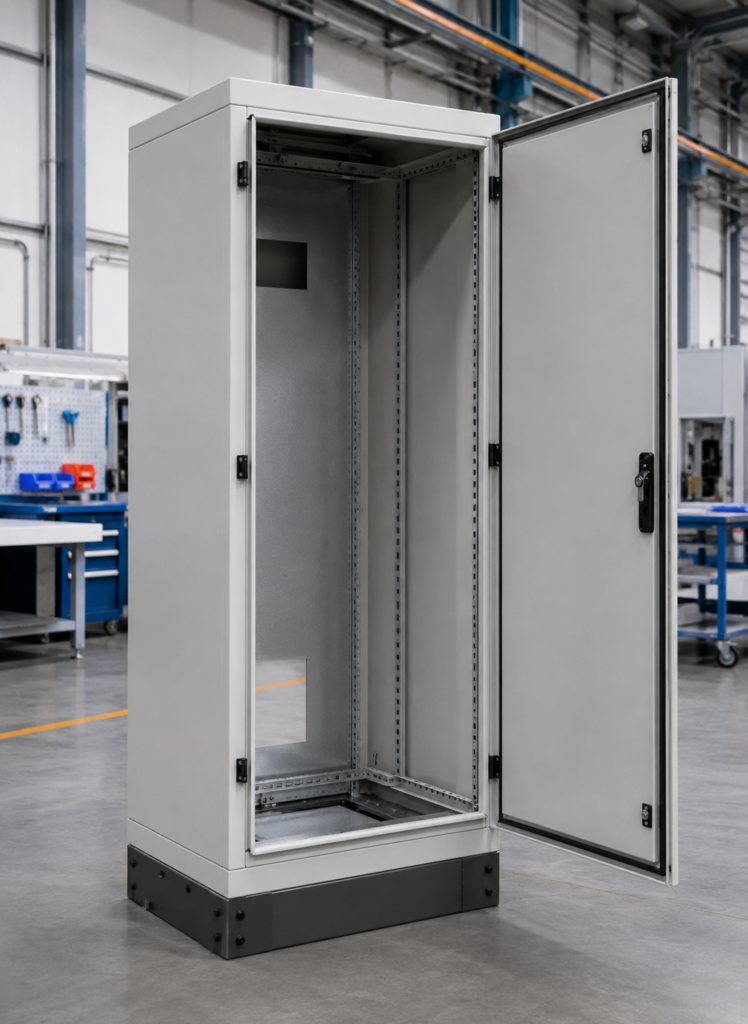
This type of product can be described as a Custom Low Voltage Control Cabinet Shell or a Custom Electrical Enclosure for Industrial Control Systems. The supply scope can include the cabinet shell, door panel, mounting plate, bottom panel, side panels, top panel, locks, hinges, sealing gaskets, grounding studs, gland plates, cable entry cut-outs, ventilation holes, fan or filter cut-outs, surface coating, and export packaging.
12. Materials and Surface Treatment
Cabinet materials can include cold-rolled steel, galvanized steel, stainless steel 304, or stainless steel 316. Cabinet thickness can be selected according to size and load-bearing requirements, such as 1.2mm, 1.5mm, 2.0mm, or higher. Powder coating can be used for surface treatment, with custom RAL colors available. For large free-standing cabinets, plinths, reinforcements, or thicker mounting plates can be added to reduce deformation risks during transportation and assembly.
13. Applicable Control Systems
This product is a semi-finished cabinet shell and does not include a complete control system. The cabinet can be used to install PLCs, VFDs, circuit breakers, terminal blocks, power supply modules, gateways, communication modules, smart meters, push buttons, indicator lights, and other low voltage control components. Related designs can refer to standards such as IEC/EN 62208 and IEC/EN 60529 for electrical enclosures and protection ratings.
14. Project Implementation Support
ZenviaFab can provide an initial review based on the customer’s cabinet dimensions, application scenario, internal component layout, cut-out drawings, surface treatment requirements, and quantity. If the customer only has sample photos, old cabinet photos, or basic dimensions, these can also be used for initial discussion before confirming formal drawings and production details.
15. Structure Feasibility Check
Before final quotation and production, ZenviaFab can help check whether the cabinet dimensions are reasonable, whether the door panel is likely to deform, whether the mounting plate has enough strength, whether cable entries are convenient for wiring, and whether ventilation holes or fan positions may affect protection rating or internal component layout.
16. Drawing and Cut-Out Confirmation
During project development, details such as door cut-outs, mounting plate hole positions, gland plate dimensions, grounding positions, lock positions, hinge direction, cable entry direction, and accessory lists need to be confirmed. Confirming these details in advance helps reduce on-site rework, additional cutting or drilling, and inconsistency in batch delivery.
17. Production Process
Cabinet production usually includes laser cutting, punching, bending, welding, grinding, powder coating, and assembly. Each process affects the final cabinet’s dimensional accuracy, structural strength, appearance quality, and assembly stability. Therefore, production process control is very important for custom enclosure projects.
18. Quality Inspection
Before shipment, inspection can cover cabinet dimensions, hole positions, door gaps, door opening and closing, mounting plate flatness, coating appearance, color, accessory quantity, and packaging condition. For export projects, packaging should focus on protecting cabinet doors, corners, coated surfaces, mounting plates, and accessories to reduce scratches, deformation, and door misalignment during transportation.
19. Application Benefits
After cabinet dimensions, mounting plate layout, door cut-outs, and cable entry design are confirmed in advance, customers can install PLCs, VFDs, circuit breakers, terminal blocks, and power supply modules more smoothly, reducing temporary adjustments on site. For multiple cabinets or multi-site projects, consistent cabinet dimensions, hole positions, colors, accessories, and packaging methods help customers replicate the same assembly process more efficiently.
20. Cost and Quality Value
By reducing on-site cut-outs, coating repair, assembly rework, and transportation damage, customers can lower hidden costs during project execution. For panel builders and automation equipment manufacturers, the higher the cabinet consistency, the lower the later labor assembly cost, quality inspection cost, and project communication cost. Custom cabinet shells can also better match internal component layouts and site installation conditions, reducing problems such as insufficient space, difficult wiring, door interference, cut-out deviation, and packaging damage.
21. Return on Investment
The value of custom low voltage control cabinet shells mainly comes from reducing on-site secondary cutting and coating repair, reducing rework caused by mismatch with internal components, reducing cabinet transportation damage and repair costs after arrival, improving batch cabinet consistency, and reducing the time required to reconfirm cabinet details for each new project.
22. FAQ
Can we work with only an internal component list but no complete cabinet drawing?
An initial review is possible, but before final quotation, it is better to confirm cabinet dimensions, internal layout, cut-out requirements, installation method, and surface treatment. A component list alone is usually not enough because wiring space, heat dissipation space, and installation or maintenance space may be overlooked.
Does the semi-finished control cabinet shell include electrical components?
Usually not. ZenviaFab mainly provides the cabinet shell, mounting plate, cut-outs, surface treatment, locks, hinges, sealing gaskets, cable entries, and packaging. Electrical components can be installed by the customer, system integrator, or local electrical contractor.
Can we make RAL colors and custom cut-outs according to European customer requirements?
Yes. Cabinet color, dimensions, door cut-outs, mounting plate layout, cable entries, logo, locks, and packaging methods can be customized according to drawings or project requirements.
What types of customers are suitable for this cabinet?
This type of cabinet is suitable for panel builders, automation system integrators, equipment manufacturers, pump station project contractors, food machinery manufacturers, factory retrofit project suppliers, and similar industrial customers.
Why not directly purchase standard control cabinets?
Standard control cabinets are suitable for simple applications. However, when a project involves special dimensions, complex cut-outs, internal component layout, heat dissipation, cable entries, batch consistency, or export packaging, a custom cabinet shell can better reduce later rework and on-site adjustments.
If you are looking for a custom electrical cabinet shell supplier for control cabinets, distribution cabinets, automation equipment, or factory retrofit projects, you are welcome to send us drawings, sample photos, internal component layouts, or project requirements. ZenviaFab can help evaluate cabinet structure feasibility and provide a custom quotation based on your dimensions, material, cut-outs, mounting plate, surface treatment, and packaging requirements.