1. Project Overview
Coastal wastewater treatment, stormwater pump stations, municipal infrastructure, and coastal drainage systems in Europe often require outdoor electrical control cabinets with long-term reliability. These projects are exposed to salt mist, high humidity, strong wind, rain, snow, low temperatures, and day-night temperature differences. Therefore, the enclosure must protect internal control components while helping reduce system failure risks caused by condensation, corrosion, and on-site maintenance issues.
2. Client Background
In coastal pump station projects, the original cabinets are often painted mild-steel enclosures used to protect pump control systems, telemetry systems, and communication equipment. After long-term use, ordinary painted steel cabinets may suffer from cabinet corrosion, coating aging, seal failure, internal condensation, control relay faults, and communication hardware failures.
3. Site Environment Challenges
Pump stations in European coastal areas are usually exposed to salt mist, high humidity, strong wind, rain, snow, and day-night temperature differences. Some older pump stations or municipal retrofit projects also face limited installation space, placing higher requirements on cabinet dimensions, door opening direction, cable entry positions, internal layout, and future maintenance accessibility.
4. Typical Technical Requirements
Coastal pump station enclosures usually need to withstand salt mist and high-humidity environments, and high-grade stainless steel is recommended for external pump control cabinets and telemetry cabinets. The cabinet should provide IP66 sealing to prevent wind-driven rain, moisture, and dust ingress. Anti-condensation design is also needed to reduce electronic component failures caused by winter conditions, nighttime cooling, and day-night temperature differences. For older station retrofit projects, compact structure and well-planned cable entry layout are also important.
5. Cabinet Configuration Reference
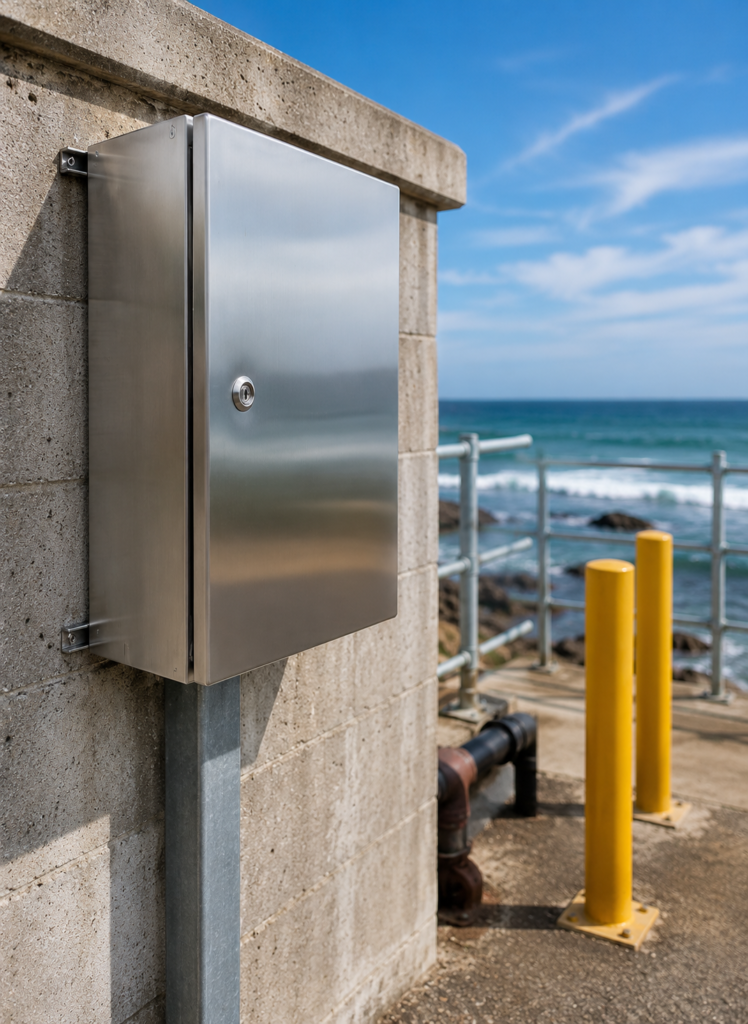
This type of pump station enclosure can be made from 316L stainless steel, suitable for coastal high-humidity, salt mist, and long-term outdoor exposure environments. Typical configurations include IP66 protection, IK10 structural strength, single-door wall-mounted cabinet design, anti-condensation heater, thermostat, IP-rated cable glands, gland plates, stainless steel mounting hardware, sealing gaskets, locks, and hinges. The material, size, and accessory configuration can be customized according to the site environment and internal component layout.
6. Applicable Control Systems
This type of enclosure is mainly used to protect pump control and communication equipment such as VFDs, PLCs, telemetry systems, control relays, and communication hardware. For wastewater treatment, stormwater pump stations, municipal water projects, and coastal drainage systems, corrosion resistance, sealing stability, anti-condensation design, and installation space compatibility directly affect long-term system reliability.
7. Project Implementation Support
ZenviaFab can help evaluate cabinet material, dimensions, protection rating, anti-condensation configuration, cable entry, mounting plate layout, door opening direction, surface treatment, and export packaging based on customer drawings, old cabinet photos, installation space, environmental conditions, and internal component layout requirements. For pump station retrofit projects requiring phased replacement across multiple sites, delivery can also be arranged according to the project schedule to help reduce impact on existing drainage, wastewater treatment, or stormwater pump station operations.
8. Installation and Delivery Support
These cabinets can usually be shipped by sea to a European port and then delivered by inland transport to the local electrical contractor or project site. To support further assembly and on-site wiring, installation drawings, cut-out drawings, cable entry position instructions, cabinet maintenance notes, material information, accessory lists, and packaging labels can be provided.
9. Application Benefits
After standardizing cabinet layout and accessories, future pump station projects become easier to replicate, and asset documentation and new project deployment processes become clearer. For multi-site municipal water projects in Europe, standardized cabinet dimensions, mounting plate layouts, cable entries, and accessory configurations can reduce the time required for redesign and on-site confirmation at each station.
10. Long-Term Maintenance Value
The upgraded 316L stainless steel enclosure and anti-condensation configuration are more suitable for European coastal environments with high humidity, salt mist, rain, snow, and low temperatures. Compared with ordinary painted steel cabinets, 316L stainless steel enclosures offer better corrosion resistance, sealing stability, and long-term outdoor reliability. This helps reduce relay and communication hardware failures caused by condensation, cabinet replacement caused by corrosion, on-site maintenance visits, and long-term maintenance pressure.
11. Return on Investment
For coastal pump station projects, return on investment is usually calculated based on maintenance cost, failure callout cost, and downtime impact. The main savings come from three areas: reducing electrical failures caused by condensation, reducing cabinet replacement caused by corrosion, and reducing on-site maintenance visits. For multi-site pump station projects, cabinet standardization can also lower future spare parts management and maintenance management costs.
12. FAQ
Why is 316L stainless steel recommended for European coastal pump stations?
European coastal areas are exposed to salt mist, high humidity, rain, snow, and day-night temperature differences over long periods. Ordinary painted steel cabinets are more likely to experience coating aging, corrosion, and seal failure. 316L stainless steel is more suitable for long-term exposure to salt mist, wind, rain, and corrosive environments.
Why does the inside of the control cabinet need an anti-condensation heater?
Coastal and northern European regions often experience clear day-night temperature differences, and condensation can occur more easily inside cabinets during winter or low-temperature conditions. Moisture can affect relays, PLCs, communication modules, and other electronic components. An anti-condensation heater helps keep the cabinet temperature above the dew point and reduces condensation-related failures.
Can we supply only the cabinet shell without electrical assembly?
Yes. ZenviaFab can provide cabinet shells, mounting plates, cut-outs, cable entries, surface treatment, and packaging based on drawings. Electrical components can be installed by the customer, system integrator, or local electrical contractor.
If you are looking for a custom stainless steel electrical enclosure supplier for coastal water, wastewater treatment, stormwater pump stations, municipal infrastructure, or outdoor telemetry control projects, you are welcome to send us drawings, old cabinet photos, installation space details, environmental conditions, or internal component layout requirements. ZenviaFab can help evaluate cabinet material, dimensions, IP protection rating, anti-condensation configuration, cable entry, mounting plate layout, door opening direction, surface treatment, and export packaging based on your pump station control system needs, helping reduce on-site rework, cabinet corrosion, condensation failures, and future maintenance pressure.
You can send us pump station control cabinet dimensions or old cabinet photos, application environment details, internal component layouts, material requirements, protection rating requirements, anti-condensation needs, cable entry requirements, gland plate requirements, mounting plate details, lock, hinge, and sealing gasket requirements, as well as quantity, packaging method, and target delivery schedule. The information does not need to be complete at the first step. Old cabinet photos, sample photos, basic dimensions, or site environment photos can also be used as a starting point for initial discussion.